Welcome

Dear Colleague,

The trainee-project ‘Applying Innovations’ looked into the “Practise what you Preach” mentality for the built environment of TNO. Could we apply innovations that TNO developed or is currently developing in our own buildings? For this we are searching for technologies that meet that criteria. Do you know innovations that have been developed by TNO in the past and could now be used for ourselves?

The goal of our trainee-project is to pave the way for the application of (pre-)competitive sustainable technologies in buildings managed by TNO. On this site you can find the process for applying innovations and you can also fill out the form to apply your Innovation!

So are you working on, or know about, a (pre-)competitive technology and do you think that your technology could be applied in the buildings managed by TNO?

Begin met schrijven of type / om een blok te kiezen

Apply Now!

Process

This webpage describes the process of how pre-competitive technologies can be applied in and around TNO’s offices. Particularly because our offices provide an opportunity to pilot our own innovations. As TNO we want to make use of our own innovations (e.g. Building Integrated PV, new ways of working, innovative materials, etc.) and show to the outside world that we practice what we preach. At the same time, it creates an inspiring and effective place of work and research. This Applying Innovations process enables utilization of the opportunity to use our own buildings as a pilot or demonstration location for our research.

This process focusses on innovations which are not ready to be marketed yet and need to be piloted. The application of the innovations offers space for continuously starting new pilots in TNO buildings. This document explains the Application procedure, the Feasibility Study phase and the Implementation Study
phase.

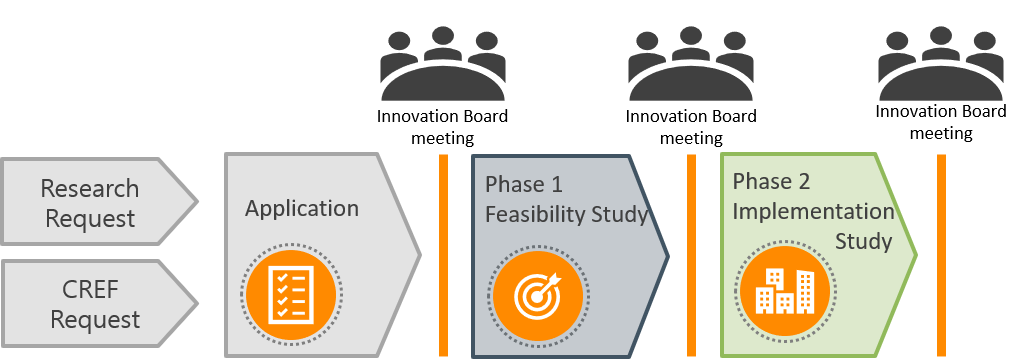
To lead this process, an Innovation Board is composed in which both the primary process and CREF are represented. The board will study the results of each Applying Innovation Phase and decide if the innovation is suitable to continue to the next phase and eventually is ready to be applied within TNO. Apart from providing advice for continuation for the next phases, the Innovation Board provides support to find and allocate funding for the Applying Innovation process. Further, Cees Henzen (Head of the team Real Estate Management & Technology, CREF) will provide guidance during the process.

Intro

Submitting your Innovation

During the whole year, innovations can be submitted to the Applying Innovation program, to be piloted in a TNO building. Submission for the Applying Innovation can arise from the primary process or as a response to a CREF request. Everyone is welcome to submit their innovation. If CREF has a request for innovations to be applied in a specific renovation/new building plan, then information of these requests (scope, requirements, timeline) can be found in the Applying Innovation tool.

In the Applying Innovations tool, an innovation can be submitted by filling in the Fast Check. The Fast Check quickly identifies the complexity, impact and risks of the pilot. These characteristics are used for the first review.


Fast check Fast Check

The application consists of a form based on which a fast check can be done on the feasibility, complexity and risks of the pilot. Five aspects are covered in the Fast Check: general description, information about the innovation (TRL, impact, added value), budget, timeline and stakeholders. In order to submit your innovation, your research manager needs to give her/his approval. 

The application will evaluated by the Innovation Board. If they decide that it seems manageable to implement the innovation in a TNO building, a project team needs to be created and they will be invited to start with the first phase (feasibility).


Phase 1: Feasibility Study

Phase 1: Feasibility Study

The goal of the first phase is to estimate if it is feasible to pilot the innovation. In this phase, the technical, social and financial feasibility and the related risks are explored. Guidance from CREF is offered for the analysis in this phase. If your application is selected to proceed with this first phase, agreements about the timeline and deadlines are made with the Innovation Board. The Innovation Board might allocate a budget to cover the hours of analyzing the feasibility – this budget is based on the estimations made in the Fast Check.

The result of this phase is a slide deck of a proposal for implementation of the innovation, including the selection of a specific building and financing options. Based on this proposal, the Innovation Board will decide on continuation to the second phase: Implementation Study.

Project team Project Team formation & Kick-off

In discussion with Cees Henzen (CREF), the submitter(s) of the innovation will compose a project team. To start the feasibility study, a kick-off meeting will be organized. This meeting will cover the feedback from the Innovation Board and decide on the most relevant actions to be taken during this phase.

Kick-Off

DMU Decision Making Unit (DMU)

In order to make the implementation of the innovation as smooth as possible, it is important to inform, and in some cases, to consult the DMU in this stage. The DMU is a collection of persons who have influence on the decision making in the process of applying an innovation. For example, think of people from TNO Corporate Services like Corporate Legal & Compliance and Information Services or management from units like ECN part of TNO, Circular Economy & Environment and Buildings, Infrastructure & Maritime.

Technical suitibility Technical Suitabilty

To implement the innovation in one of the buildings of TNO, it is necessary to have an overview of all the technical (and practical) requirements for success. These requirements are the basis for choosing the most suitable TNO location for application and assessing the impact of the innovation on the other processes running within TNO (undisturbed working environment, IT, etc..).

Midterm Review Midterm Review

During the midterm review a pre-selection of TNO buildings is made, to match the innovation with a suitable implementation location.

Planning (Alignment) Planning

Based on the suitable building, a rough planning of the activities needs to be delivered. If the innovation will be implemented in a new or to-be-renovated building this means the timeline of the primary process of building/renovating, use and maintenance and the timeline of the R&D planning of the innovation need to be aligned. If the innovation will be applied in an existing building, then only the latter R&D planning needs to be clear.

Social Impact (Social) Impact

Determine what the (social) impact of the innovation is. For example, think of the impact on the environment or on the image of TNO. Also clarify how the innovation influences the performance of the building in question and what it means for the people working in it, both during the installation and after the implementation of the innovation.

Value Case Value Case

The project team is responsible for setting up a value case and/or initial investment proposal. This proposal is twofold: One research-oriented part including research questions and one facilities part including preliminary investment costs and possible (social) gains. The project team can ask for help from the CREF team.

Finance Options Finance Options

In support of the initial investment proposal/business case, a list of possible financing source options should be drafted. These options can range from earmarked research money to subsidy schemes that could be addressed.

Risk Assessment Risk Assessment

For all the previous aspects (Decision Making Unit, technical suitability, planning, (social) impact, value case and finance options), risks can be identified that could have an impact on the application of the innovation. An overview of the risks, probability, impact and mitigation of the risks is necessary.

End phase 1 End Phase 1: Results Feasibility Study

The project team prepares a slide deck in which all the results from the feasibility analysis are combined. This includes the technical and social feasibility, the suggestion for a TNO-building and financing options.

The slide deck includes at least: Feasibility end
    • Description of the involved stakeholders (Decision Making Unit)
    • A list of all technical requirements necessary for implementation of the innovation
    • A (rough) planning combining the renovation plans of the building and the R&D planning of the innovation
    • An assessment of the (social) impact of the innovation.
    • An initial investment proposal (value case)
    • An overview of the finance options
  • A clear risk analysis, including mitigation

This slide deck will be presented to the Innovation Board who will decide if the project team can continue to the second phase ‘Implementation study’. In this meeting, a ‘go/no go’ decision is made based on the presented feasibility of applying the innovation.

Phase 2: Implementation Study

The second phase is focused on preparing the implementation of the innovation. This phase starts after approval of the results of the Feasibility Study (phase 1). First agreements about the timeline, deadlines and budget (for execution of phase 2) are made with the innovation board.

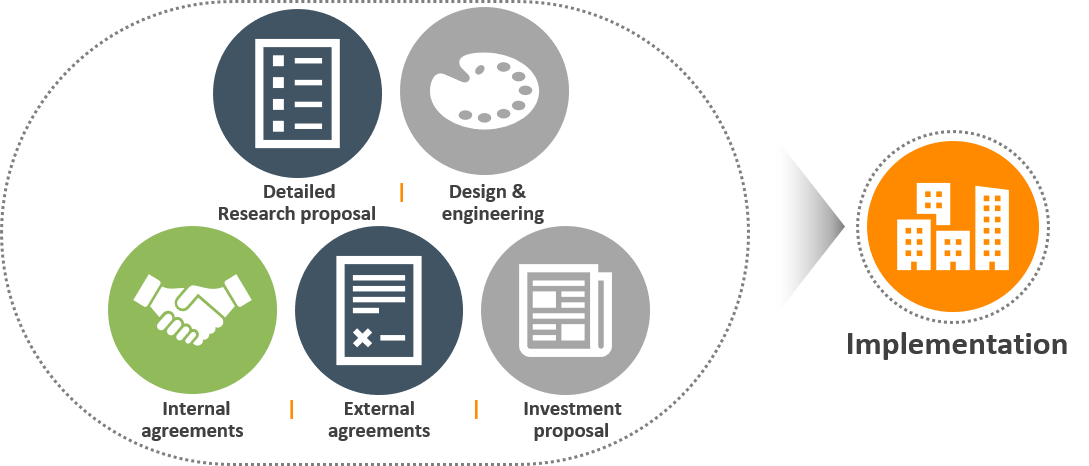
In the ‘Implementation study’ phase the project team designs the application o the technology into detail, drafts agreements with the primary process and with partners companies and decides on the investment plan. Based on these aspects, the innovation board (together with the possible financing parties) will give advice for continuation, which will lead to the application of the innovation.

Project team Kick-off

To start the implementation study, a kick-off meeting will be organised. This meeting will cover the feedback from the innovation board and decide on the most relevant actions to be taken during this phase.

Phase 2

Detailed Research Plan Detailed research plan

As this first step, the project team needs to make a detailed research plan. This plan should at least include:

  • Research objective(s) and desired outcome
  • Detailed description of the work packages
  • Responsible person/department for the workpackages

Design and Engineering Design & Engineering

Once the second phase is started, the first step is the detailes designing and engineering of the application of the innovation. The project team can be supported by the CREF team and the relevant building/renovation team.

Internal agreements Internal Agreements

All agreements with TNO Stakeholders should be discussed and drafted. These agreements cover the responsibilities during the building process use and maintenance, and the R&D planning. Depending on the innovation this includes the employees in the buildin, RM /DOO / DS / DM, catering/ cleaning, etc.

External Agreements External Agreements

All agreements with partner companies need to be drafted for final approval. This includes quotations for contracting and possibly maintenance. Since the project entails R&D, it is important to include flexibility in the contracts. Help from the CREF team and TNO Legal department is available.

Final investment Proposal Final Investment Proposal

The project team is responsible for drafting an investment proposal addressing the research questions and gains, the necessary investments and gains and a financing plan. The project team can ask for help from the CREF team.

The final proposal will be presented in a slide deck including at least:

  • A clear research goal including a detailed project description, design and engineering work
  • An investment proposal including a financing plan
  • An assessment of the impact of the proposal (on TNO’s roadmaps and society)
  • A clear description of the involved parties in the project and their role
  • Planning for both the building, use and maintenance and the R&D lines of the project

Advice Innovation Board Advice Innovation Board

The proposal is discussed in the Innovation Board meeting and depending on the proposal an advice for continuation is given by the Innovation board.

If the results from the Implementation Study show insurmountable issues which inhibit the innovation to be implemented, the Innovation Board can decide to allow the project team to run another cycle in the Applying Innovations program in order to analyze the application under different circumstances (i.e. move to another TNO building, alternative agreements, etc).

End Phase 2 End Phase 2: Signing all agreements

Phase 2 big

When the proposal is green-lighted, the financing steps are initiated, and the proposal is signed in accordance with the TNO mandate scheme.

The innovation is ready to be applied!

Apply

Apply your innovation now!


← Back

Je bericht is verzonden

Waarschuwing
Waarschuwing
Waarschuwing
Waarschuwing
Waarschuwing
Waarschuwing
Unit(vereist)

Waarschuwing
Waarschuwing

Waarschuwing!

Ontwerp een vergelijkbare site met WordPress.com
Aan de slag